What is a panel schedule, and what has to be on it?
A panel schedule is the directory that tells anyone opening a panelboard what each breaker feeds, how big it is, and which leg it sits on. NEC 408.4(A) requires every circuit to be legibly identified as to its purpose, and a permit reviewer expects the schedule to agree with the load calculation. The sample above holds 18 circuits (11 two-pole, 7 single-pole) in a 30-space panel, using 29 of 30 poles, with 20,040 VA on leg L1 and 20,040 VA on L2, an imbalance of 0.0%. Its 40,080 VA of calculated circuits reconciles to the load calculation’s 40,080 VA connected total exactly.
Updated September 23, 2026. Numbers on this page are computed by the same engine as the calculators, under NEC 2023.
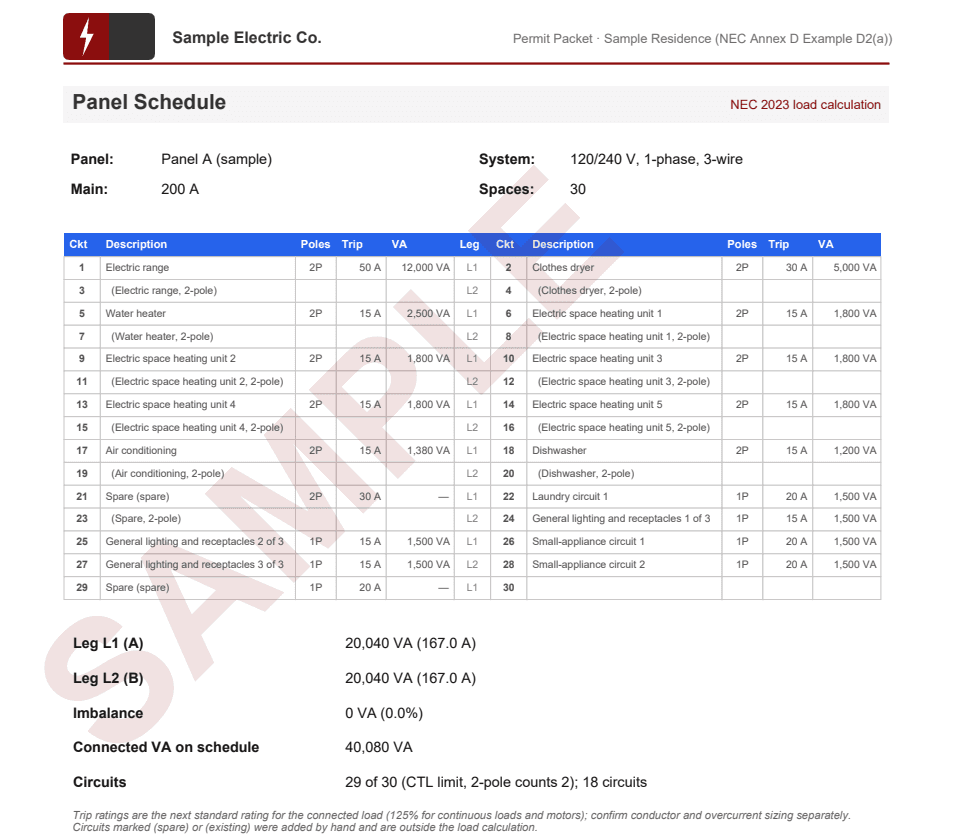
Worked example: the sample packet’s panel (Annex D Example D2(a))
Calculated per NEC 2023Standard method (Article 220 Part III) for the loads; panel schedule engine for placement
Inputs
| Dwelling | 1,500 ft², 12 kW range, 2,500 VA water heater, 1,200 VA dishwasher, 5,000 VA dryer, 9,000 VA space heating in 5 units, 1,380 VA air conditioner |
|---|---|
| Panel | 200 A main, 30 spaces, 30-circuit rating, 120/240 V single-phase |
| Circuits derived | 3 general lighting circuits at 15 A (4,500 VA ÷ 1,800 VA), 2 small-appliance and 1 laundry at 20 A, one circuit per appliance and heating unit |
| Added by hand | One 20 A 120 V spare and one 30 A 240 V spare |
Result
| Circuits on the schedule | 1811 two-pole, 7 single-pole; 29 of 30 poles |
|---|---|
| Leg L1 / Leg L2 | 20,040 VA / 20,040 VA167.0 A / 167.0 A at 120 V; imbalance 0.0% |
| Connected on schedule | 40,080 VAevery circuit placed |
| Reconciliation to the load calc | Reconciled40,080 VA of calculated circuits vs 40,080 VA connected |
Two-pole loads (range, dryer, water heater, five heating units, air conditioner) are placed first in adjacent spaces of one column; the single-pole circuits then go to whichever leg is lighter. The result is 20,040 VA on each leg, 0.0% imbalance, and a schedule whose calculated circuits add up to the load calculation’s connected total.
- Trip ratings are the next standard 240.6(A) rating for the connected load, 125% for continuous loads and motors; conductor sizing is confirmed separately.
What the columns mean
Reading across one row of the sample: circuit number, description, poles, trip rating and VA on the left; the leg marker in the middle; and the same five columns for the right-hand circuit.
- Circuit number. Odd numbers run down the left column, even down the right, and each pair of rows alternates between leg L1 (A) and L2 (B). A 2-pole breaker occupies a space and the one below it in the same column (1 and 3, not 1 and 2), which is how it reaches both legs.
- Description. 408.4(A) requires the purpose, specific enough to identify it ("Small-appliance circuit 1", "Clothes dryer"), and not dependent on transient conditions such as who lives in a room.
- Poles and trip. 1P or 2P and the breaker rating. Tandem halves print as 17A / 17B within the space row.
- VA and leg totals. The connected VA per circuit lets the schedule report each leg’s load and the imbalance, which is what a reviewer uses to see that the single-pole loads were balanced.
Why it has to reconcile
A panel schedule that lists loads not in the calculation, or omits ones that are, tells the reviewer one of the two documents is wrong. The schedule builder derives its circuits from the saved load calculation, one circuit per physical unit, so the calculated circuits sum to the calculation’s connected load. Spares and existing circuits are marked as such and excluded from that comparison, and the reconciliation card states the delta when there is one.
What goes in the permit packet
The schedule page prints after the load calculation in the permit packet with the same header and footer: panel name, system voltage, main rating and spaces at the top, the two-column table, and leg totals, imbalance and circuit count below. Spaces left open print blank so the inspector can see the spare capacity.
Frequently asked questions
- Is a handwritten directory on the panel door enough?
- For 408.4(A), a legible directory on the door meets the code. For a permit submittal, reviewers increasingly want a typed schedule with trip ratings and loads that matches the calculation; the printed page is that document, and it can also be taped inside the door.
- Why does the imbalance matter?
- The service neutral carries the difference between the legs. Keeping the single-pole loads balanced keeps neutral current low and avoids one leg loading the main breaker while the other idles. The engine balances to within a fraction of a percent on the sample; the tool shows the figure so you can judge hand placements.
- Do spares count in the totals?
- Spares carry 0 VA so they do not change the leg totals, but they do occupy spaces and count toward the circuit limit. They are marked "(spare)" on the schedule.
- Can I move circuits by hand?
- Yes. Drag a circuit to a space (or its A/B tandem half) and it is pinned there; auto-assign fills around pinned circuits and re-balance releases them. The validator flags overlaps, illegal tandem halves and the circuit limit as you go.
Related questions
- Are tandem breakers allowed, and how many can a panel take?Yes, where the panelboard is listed for them. What the CTL limit and the "30/40" on a panel label mean, and a panel schedule engine placing 36 circuits in a 30-space, 40-circuit panel versus a 30/30 panel.
- What does a 200 A service load calculation look like, line by line?A complete NEC 2023 Article 220 standard-method calculation for a 2,400 ft² all-electric house with a heat pump and well pump, every line item with its clause, plus the 220.82 optional method on the same house.
More for electricians: NEC 2023 load calculations you can hand to an inspector · all answers